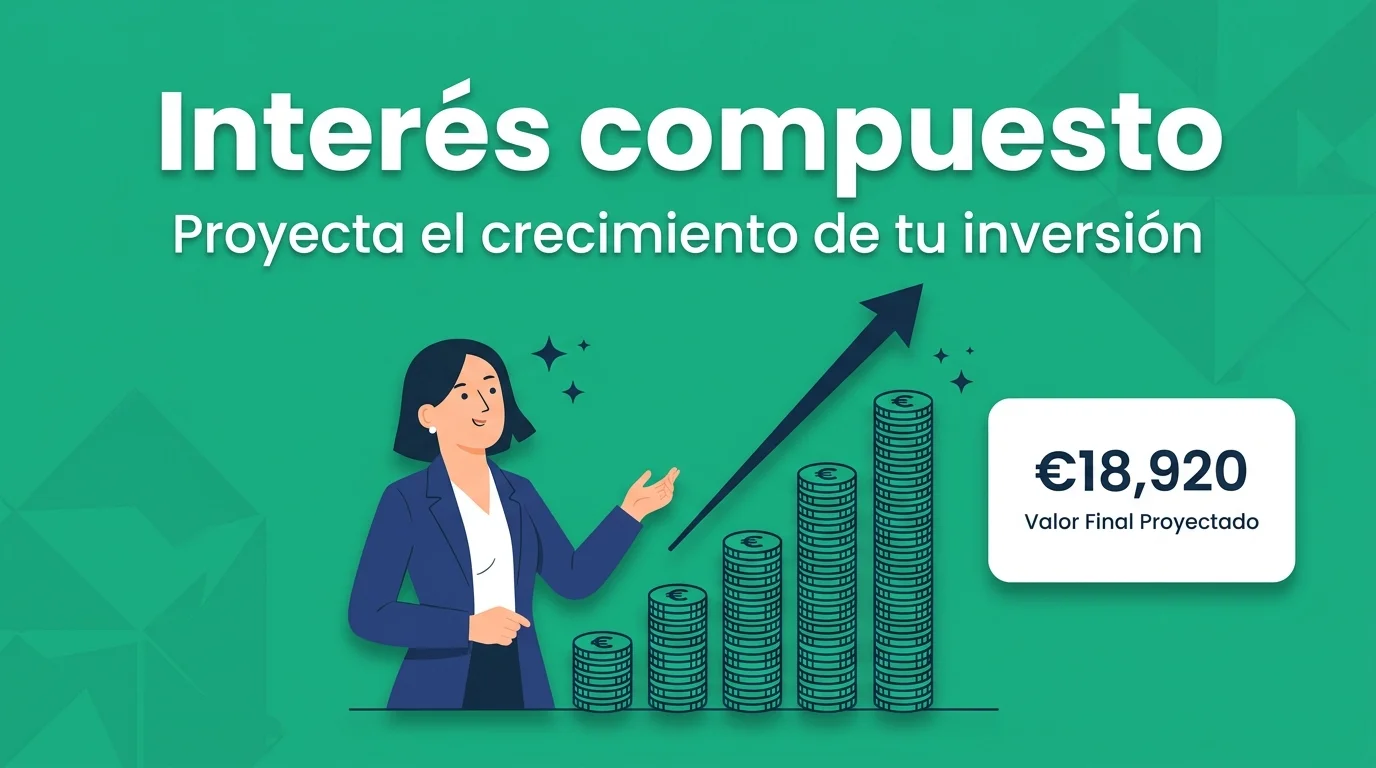
Your $5,000 bonus in an index fund grows slowly the first year and suddenly, at year ten, interest earns more than what you contribute each month. That is compound interest: returns on returns, not just on the initial principal. Without simulating it, you underestimate how much discipline with $100 monthly contributions can be worth.
Simple interest always adds on the original principal. Compound reinvests earnings and accelerates the curve over time —time is the variable that matters most. FORMARTIO projects scenarios so you see the effect in numbers, not empty motivational phrases.
Real example: $1,000 initial + $100/month for 5 years at 5% annual
Initial investment: $1,000. Monthly contribution: $100. Term: 5 years = 60 months. Average annual compounded return: 5% —≈ 0.407% monthly effective simplified.
Total out-of-pocket contributions: 1,000 + (100 × 60) = $7,000. With approximate 5% annual compound interest, final value: ~$8,350–$8,500. Gain over contributed: ~$1,350–$1,500 —nearly 20% extra without raising contributions.
Same plan without compound interest —just $7,000 saved—: you lose those ~$1,400 in returns. Compound interest rewards starting early even when the amount is modest.
Same example at 10 and 20 years
10 years, same $100/month, 5% annual, $1,000 initial: contributed $13,000, approximate final value ~$16,500. At 20 years: contributed $25,000, approximate final value ~$41,000. The curve steepens toward the end —patience matters more than perfect market timing.
Step by step to calculate compound interest
- Define initial capital if you have it —can be 0.
- Set periodic contribution —monthly, quarterly— and how much you can sustain over time.
- Estimate realistic annual return —5% conservative long term, less for savings accounts.
- Open the Compound Interest Calculator on FORMARTIO and enter variables.
- Compare scenarios: more contribution vs more years vs one extra point of return.
Compound interest on debt —the dark side
Credit card at 22% APR: unpaid balance also compounds against you. $3,000 unpaid grows fast. Same math, opposite sign —pay off high-interest debt before aggressive investing.
Interest-only loan: you do not reduce principal; compounding works for the bank. Understand the product before signing.
Inflation and real return
5% nominal with 3% inflation ≈ 2% real purchasing power. Compound interest in the simulator is gross; mentally subtract inflation for long retirement plans.
Stepped contributions —raising $100 to $150 at year 5— accelerate the final more than chasing extra risky return.
Projection mistakes
Assuming 12% annual constant because one year the fund did it. Using compound interest for a 6-month period in a zero-interest checking account —minimal impact. Withdrawing gains each year turns compound into simple.
Ignoring fund or ETF fees: 0.5% annual fee eats compounded return over decades.
Tax-advantaged account: net compound interest after tax at withdrawal may differ from gross simulation —read product terms.
DCA —fixed periodic contribution— smooths volatility; compound interest simulator assumes average rate, not the market's worst or best month.
If you hesitate between spending an extra $100/month or investing it, look at the 15-year projection. Calculate compound interest on FORMARTIO, try your monthly contribution, and let the numbers speak without rushing.