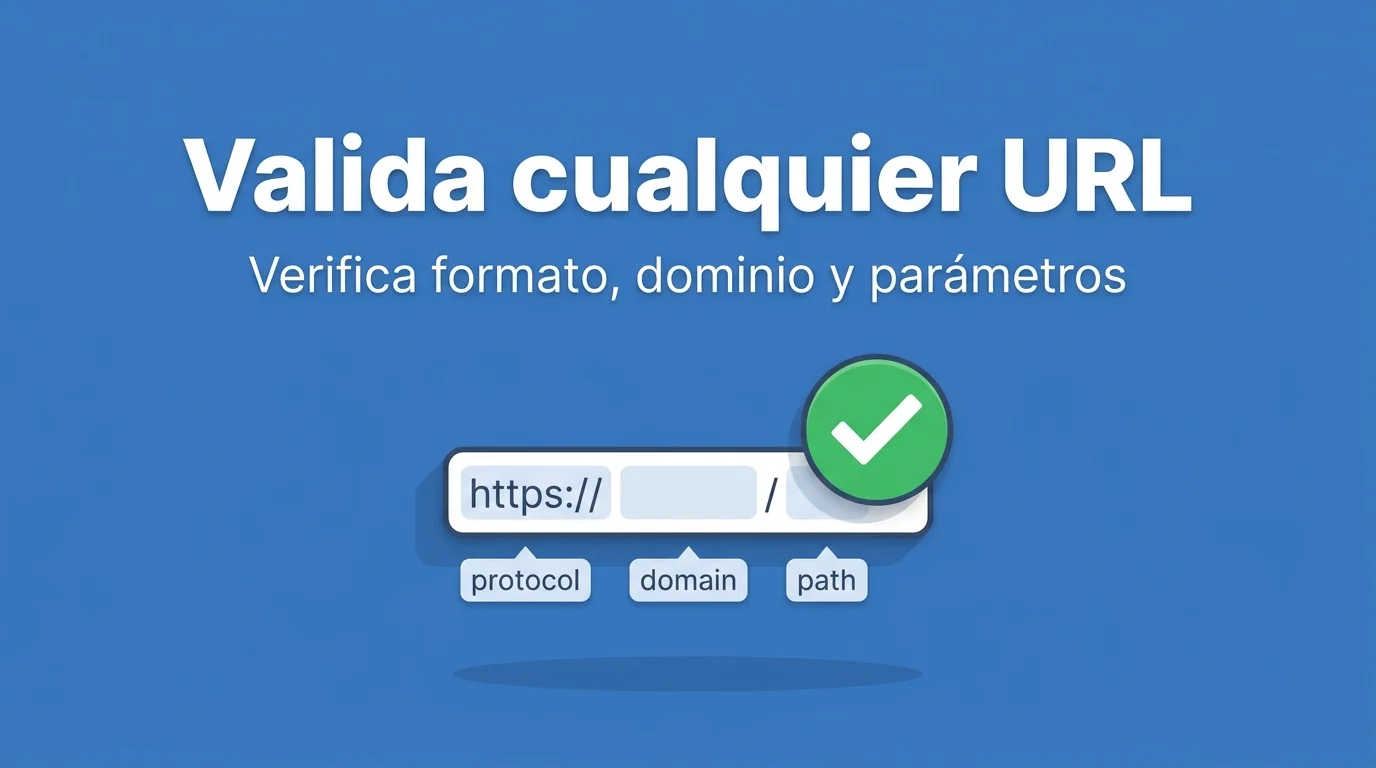
You deploy the "Buy" button with href="htps://store.com" — typo in the scheme — and nobody buys until someone tests it by hand three days later. Or you paste a thousand URLs in a CSV for a campaign and several have invisible trailing spaces. A url validator catches the error before production or mass send.
A valid URL does not mean the site exists or returns 200; it means the structure follows rules — scheme, host, escaped characters. Separating syntax from availability saves debug time. FORMARTIO validates in the browser on the fly.
What a url validator checks
http or https scheme present, non-empty host, allowed characters encoded, numeric port if present, reasonable path. Some validators flag IDN and punycode on international domains.
It does not replace curl: a syntactically perfect URL may return 404 or expired SSL. Validate form first, then ping or fetch if you need uptime.
Step by step to validate a URL
- Open URL Validator on FORMARTIO.
- Paste the full URL as it will go in the email or code.
- Run validation and read the specific error message if it fails.
- Fix scheme, host, or encoding as the tool indicates.
- Validate again until OK, then publish or commit.
Typical errors in campaign URLs
Unencoded spaces — my page.html. Accidental double slash — .com//path. Parameters with & unescaped in HTML — breaks href attribute. Semicolon instead of ? before query copied from Word.
A url validator detects broken form; in HTML remember to escape & as & in static attributes.
URLs in code and configs
Webhook URL in staging vs prod .env: validate both before deploy. Badly formed OAuth redirect callback fails in horribly silent auth debugging.
Mobile app deep links — myapp://path: different rules than https; use a validator that accepts custom schemes if applicable.
Mass link lists
Partner CSV import: website column with http missing //, truncated domains, emails in URL column. Validate batch or random sample before integrating into public directory.
CMS migration: badly written 301 redirects duplicate content or create loops. url validator on origin → destination chain before uploading .htaccess or nginx config.
Url validator vs SEO
Badly written canonical — relative when it should be absolute — passes syntax but confuses Google. Validation + manual intent review.
Broken links in sitemap XML: syntax OK, destination 404. Combine validator with periodic crawler; each tool covers one layer.
UTMs pasted with unencoded characters — ñ in campaign without %: url validator helps normalize before utm generator and send.
mailto links: url validator differs from https; do not paste email in web URL field without correct scheme.
Url validator in CI/CD
Pre-deploy script that fails build if config contains invalid href in static content JSON: cheap to add, expensive to skip when marketing publishes a hundred landings.
Deep link tested in staging: url validator confirms syntax before publishing in App Store metadata that Apple rejects if custom scheme is malformed.
A url validator does not replace checking expired SSL certificate; perfect href to domain with broken TLS is still a bad experience for the end user.
Before sending ten thousand emails with a broken button, spend ten seconds on the link. Validate your URL on FORMARTIO, fix the scheme typo, and deploy with an href that actually reaches the store.